

Candlelight services
Church records of Christmas vigils, hymn lists, and seasonal baptisms

⛯ Across Appalachian congregations, winter services condensed community memory into ceremony and ink. Christmas vigils gathered households beneath low light where scripture, hymn singing, and prayer moved in a steady cadence that carried names into the record. Clerks noted attendance, visiting ministers, and the order of worship, while sacristy books marked baptisms and confirmations timed to the season. Hymn lists—often copied by hand—fixed the musical spine of the night, pairing familiar tunes with local variations. When read together, these sources reveal how churches served as repositories of winter ritual, turning devotional practice into genealogical evidence of who was present, what was sung, and which families marked religious milestones at year’s end
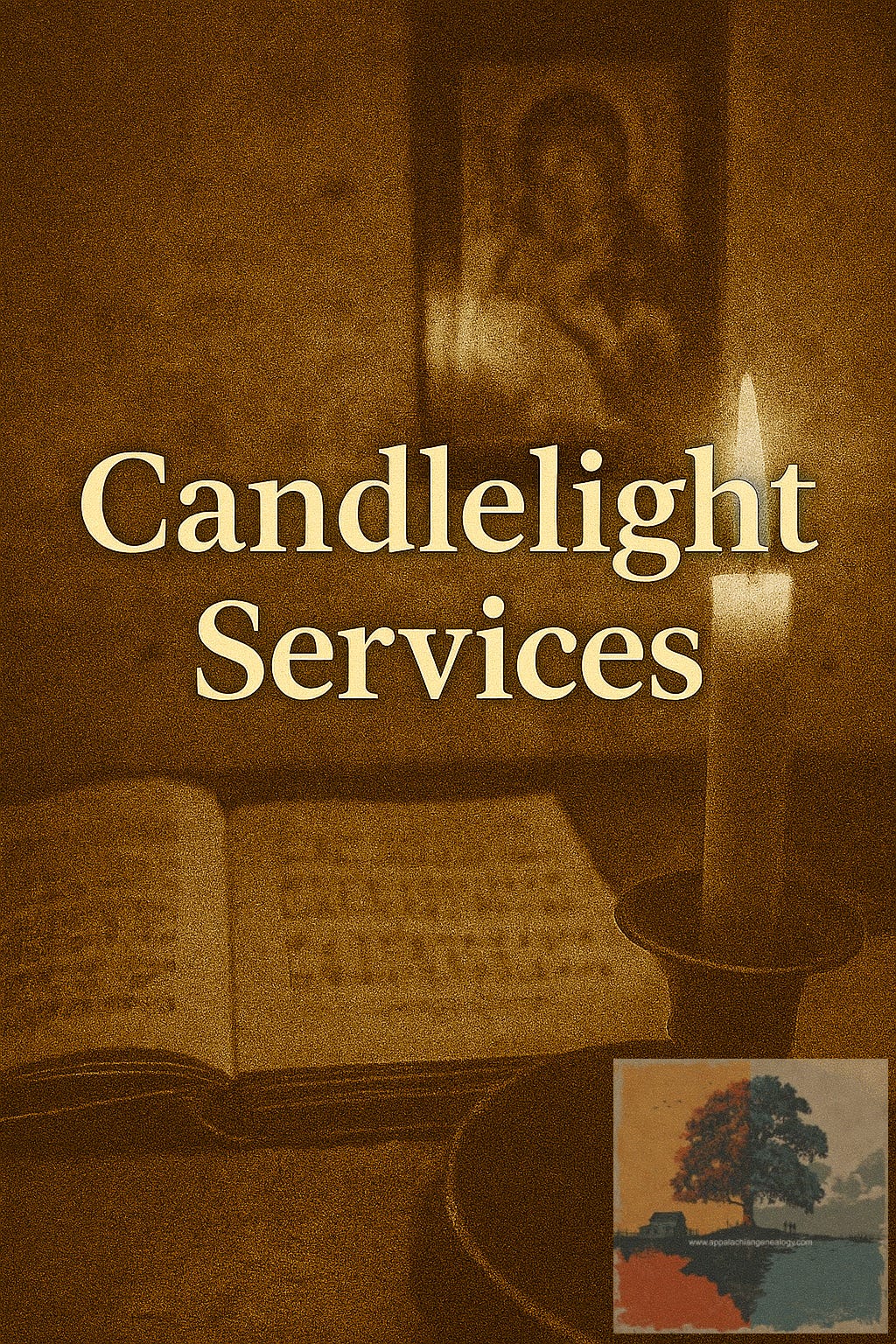
🕯️ Vigils, minutes, and seasonal notation
Candlelight services appear in church minutes and bulletins with entries that identify date, time, officiants, and the reason for gathering. Winter notations frequently add context—snow on the ridge, roads passable only by foot, lanterns carried from home to church—and they name those who assisted: sextons, choir leaders, readers, and visiting kin. Such details stabilize the record geographically and socially, situating families within the congregation’s winter rhythm. Genealogically, a vigil entry may be the only place a traveling relative appears in the local archive, or the clearest evidence that a family remained in place despite weather that limited mobility.
🎶 Hymn lists, program orders, and the musical archive
Hymn lists copied into minute books, choir notebooks, and printed or handwritten programs preserve the sound of the service: tune names, numbers, and seasonal selections. Variants and local favorites—whether drawn from denominational hymnals or regional compilations—signal tradition and teaching lines within the congregation. Marginal notes identify soloists, children’s choirs, or community singing that involved neighboring churches. For genealogy, these lists tie surnames to roles and participation, mark interchurch connections, and provide dates that align with family presence in pews or choirs. A program that names a child reader or song leader places that person inside a winter rite where attendance was recorded with unusual care.
💧 Baptism registers and year‑end sacraments
Seasonal baptisms clustered around Christmas and early Epiphany appear in sacramental registers with dates, parents’ names, sponsors or witnesses, and officiants. Winter entries often include practical notes—fonts warmed, baptisms moved indoors, scheduling adjusted for weather—which add texture to the event. These registers anchor kinship terms to a specific day and congregation, offering corroboration for family Bibles and winter diaries. For researchers, sponsor names expand kin networks, while officiant notes point toward denominational circuits and clergy itineraries that can explain why certain families appear together at year’s end.
🏛️ Denominational context and local practice
Appalachian congregations—Baptist, Methodist, Presbyterian, Holiness, and others—kept records with denominational patterns but adapted to local conditions. Where hymnals or printed programs were scarce, handwritten lists substituted; where lighting was limited, services condensed; where ministers traveled between churches, minutes note shared vigils and combined baptisms. Understanding these practices helps genealogists interpret gaps or overlaps. A joint service entry may place two communities in the same room on a single winter night, while a borrowed minister’s name can connect records across county lines.
🧭 Interpretive care and corroboration
Church records should be read alongside newspapers, cemetery surveys, civil registrations, and oral histories to confirm dates and participants. Program orders may omit late changes; hymn lists can be recopied after the service; baptism entries sometimes reflect scheduling rather than the exact day ritual occurred. Corroboration brings clarity without diminishing the church book’s value as a primary witness. Treat each winter entry as a focal point that radiates outward to household diaries, sponsor families, and neighboring congregations.
📚 Resource box
Church minutes and program orders (vigil dates, officiants, hymn sequences)
Choir books and hymn lists (participants, seasonal selections, local variants)
Baptism and confirmation registers (parents, sponsors, witnesses, officiants, dates)
Denominational records and clergy itineraries (circuit schedules, shared services)
Newspapers and community notices (service announcements, weather notes, attendees)
Family Bibles and winter diaries (parallel entries and corroborating details)
🪧 Candlelight made the sanctuary a ledger of presence. Names entered the book beside hymns sung from memory, and water marked the winter’s passage with witness and kin. Read carefully, these records return us to the pews where Appalachian families gathered despite the cold, keeping faith and leaving a trail of ink for those who follow.