

Three Counties, One Family: How to Research Any Appalachian County Split
A research guide for the years your family vanished into three different courthouses at once

📚 Paid subscribers: The Border Family Toolkit: Finding Ancestors Through Any County Split is waiting in the Resource Library.
🔍 Free Members: Learn more about the benefits of Free vs. Paid. Click here.
🌲Support us by shopping our Amazon recommendations page. As an Amazon Associate, we earn a commission for each purchase, which keeps us going. 💚 Or, you can Buy Us a Coffee.

Across Appalachia, county after county was carved out of older ones, and every split did the same thing to the families living near the new line. A family's paper trail split across two or three courthouses, so if you don't know how to work that gap, your ancestor can look like they vanished for years, whether the split happened in Kentucky in 1878, Virginia in 1856, or Tennessee in 1801.
🗺️ The Problem Nobody Warns You About
County formation doesn’t just redraw a line on a map. It splits a single family’s paper trail across two different courthouses, sometimes mid-decade, sometimes mid-document. A man filed a deed in one county in 1876; he filed his next one in a brand-new neighboring county in 1879, and nothing about his life changed except which clerk’s office held the book.
This happened constantly across Appalachia, anywhere a new county was organized from older ones. Kentucky alone created well over a hundred counties this way. Virginia, Tennessee, North Carolina, and West Virginia repeated the pattern, often well into the early twentieth century. Records don’t switch over on the exact day a county is born. Surveys, deeds in progress, and pending court matters often finished out under the old county’s authority even after the new one existed on paper, because the people directly affected didn’t always know or care which courthouse held jurisdiction that particular month.
This problem trips up more researchers than almost any other in Appalachian research, and it doesn’t announce itself. A family doesn’t vanish all at once. A birth here, a marriage there, attached to a county name that doesn’t match the one in your tree, until you’ve convinced yourself the line died out. Most of the time they didn’t go anywhere. The courthouse changed underneath them, and nobody told the family, the clerk, or the county nine miles down the road.
🧭 Genealogical Connection: Working Any County Split
This method works the same way no matter which Appalachian county split you're untangling. Leslie County's 1878 formation out of Clay, Harlan, and Perry serves as the working example below, but swap in any new county and its parent counties and the steps hold.
📋 Find the exact parent county or counties before you search anything else. Every state archive or genealogical society keeps a county formation chart showing which older county or counties a new one was carved from, and when. For Leslie County, that means Clay, Harlan, and Perry; for your family’s split, it will mean something else entirely. Pull that chart first, not last.
📋 Search the parent county first for anything before the formation date. Land grants, tax lists, and court minutes generated before a split live in the parent county’s records, not the new county’s. Leslie County’s order books begin in 1878, the year of formation, so anything earlier sits in Clay, Harlan, or Perry. Searching the new county first for a pre-split ancestor means searching a courthouse that didn’t exist yet, regardless of state.
📋 Treat the formation date as the start of a transition zone, not a hard line. New counties typically take several years to fully take over recordkeeping from their parent counties, and land records in particular often predate a county’s organization, since the underlying surveys carried over unchanged. A deed referencing land in the new county the year after formation might still cross-reference an older parent-county survey. That overlap can run anywhere from a year to a decade, depending on the state and the county.
📋 Pull the index before the individual order books. Most county courts and circuit courts kept indexes covering decades at once, so you can often search a name across a long span in one place rather than paging through individual volumes year by year. Leslie County’s circuit court holds a civil case index running from 1878 to 1940. Ask your target county’s clerk or its FamilySearch wiki page what comparable indexes exist there.
📋 Run the FAN method across the county line, not just within it. The friends, associates, and neighbors who witnessed a deed in the old county show up as neighbors in the new county’s earliest records too. If your ancestor disappears from the parent county’s records right around the formation date, check whether their known associates reappear in the new county first. That tells you which direction to look before you’ve found your own family there directly.

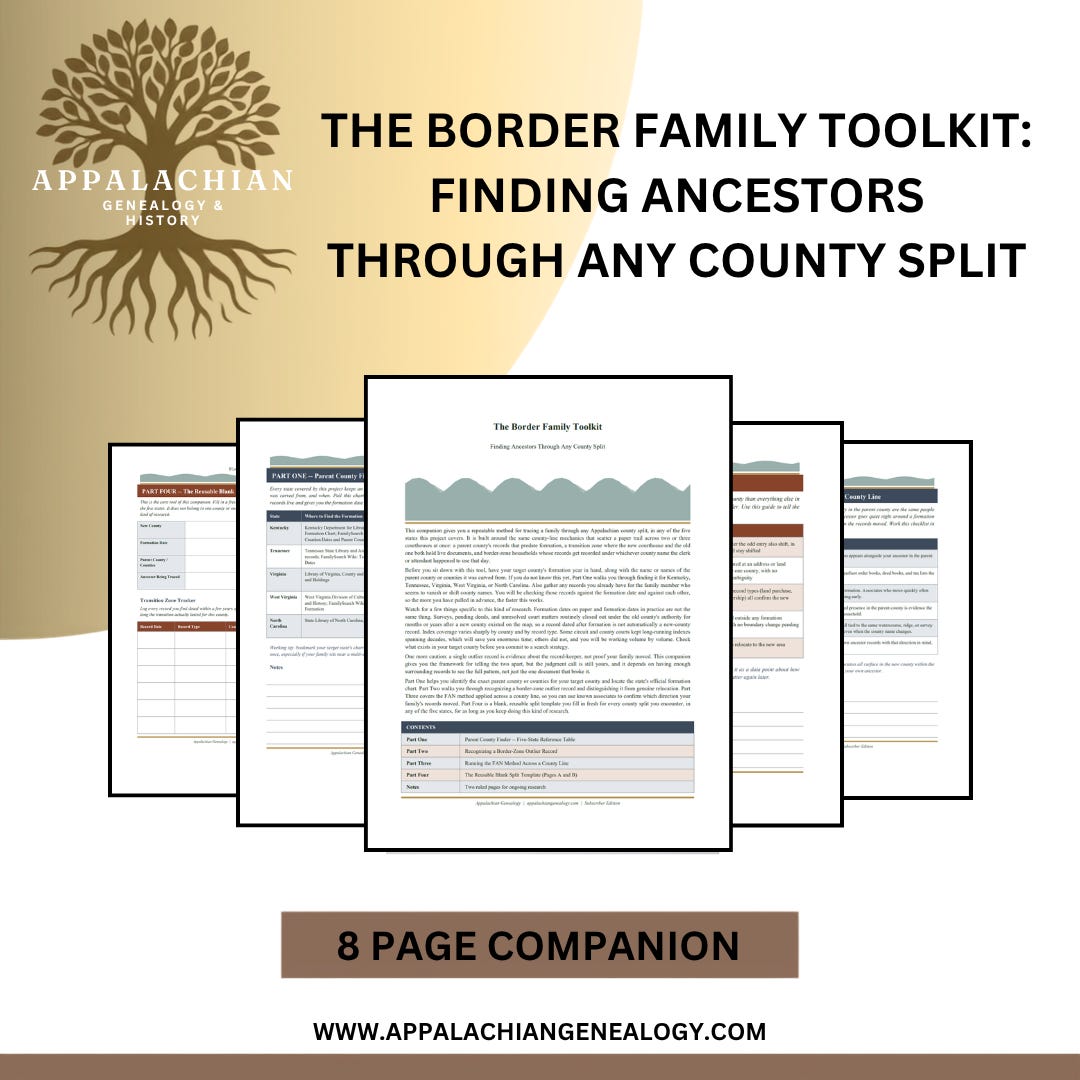
The Border Family Toolkit: Finding Ancestors Through Any County Split
When a family disappears from your tree right around a county formation date, the records did not vanish — the jurisdiction did. This companion gives you a repeatable method for tracing a family through any Appalachian county split. You get a worksheet for identifying which parent county held the records before the new county formed, a guide to spotting border-zone outlier records, a checklist for applying the FAN method across a county line, and a blank template you can adapt for any split your research runs into anywhere in Kentucky, Tennessee, Virginia, West Virginia, or North Carolina.
8 page PDF research guide includes:
Five-state parent county finder reference table with exact sources for Kentucky, Tennessee, Virginia, West Virginia, and North Carolina county formation charts
Border-zone outlier record interpretation guide with a five-signal table for distinguishing a recording error from a genuine family relocation
FAN method checklist for running known associates across a county line in six steps
Reusable blank split template with transition zone tracker, outlier record log, FAN-across-the-line tracker, and conclusion prompt, built to be refilled for every county split encountered
Notes and search log pages

📂 From the Archives: One Family, Three County Names
Here’s what this looks like in an actual record run, not just in theory.
Eli W. Burns was born in February 1878 in Owsley County, Kentucky. By 1880 he was listed as a single son in his father John Dandy Burns’s household in Buffalo, Owsley County. He married Martha Napier in 1896, and the family’s children’s births start showing up recorded in Big Creek, Leslie County, beginning with a daughter in 1898. The 1900 census places the family in Leslie County, consistent with those birth records (Hamilton Smith Family Tree 2026).
Then, in 1910, a son named Ray Burns shows up as born in Clay County, Kentucky, on July 27 of that year. The same family’s 1910 census entry, taken that April, lists their residence as Big Creek, Leslie County (Hamilton Smith Family Tree 2026). Two records from the same year, the same family, the same approximate location, and two different county names.
This is not a contradiction to resolve by picking one record as wrong; it’s the normal texture of life along a county line in rough terrain. Big Creek sits near enough to the Clay-Leslie border that a birth attendant, a midwife, or a county clerk recording the event after the fact could reasonably place it in either county, depending on exactly where the household stood, which road they traveled to reach help, or simply which county the recorder was used to writing down. The family’s other records, the 1900 and 1920 censuses, the earlier and later children’s births, all sit firmly in Leslie County. The 1910 birth entry for Ray is the outlier, and a researcher needs to recognize it as one rather than chase it as a sign the family moved and moved back.
The rest of this family’s paper trail explains why that distinction matters so much for confirming identity. Between 1898 and 1917, Eli and Martha had ten recorded children, and with one exception, Ray, every birth location holds steady at Big Creek, Leslie County. The 1920 census shows the family still there, with Eli listed as head of household. A son, Mitchel, died in Leslie County in 1922. Eli himself disappears from the record sometime before 1940; the 1930 census is the last document to place him, and the 1940 census records Martha as a widow (Hamilton Smith Family Tree 2026).
Lay all of that out side by side, and Ray’s 1910 Clay County birth record stops looking like a mystery. It becomes exactly what it is: one clerk, one form, one moment where the paperwork didn’t match the family’s actual, unbroken residence at Big Creek. A researcher who found only that single birth record, with no surrounding census run to anchor it, would naturally assume a family that moved to Clay County around 1910 and moved back. The full record set says otherwise, and that gap between what one document suggests and what the full pattern proves is exactly where county-split research goes wrong, and exactly where it gets corrected.
🏛️ Why It Matters: What One Outlier Record Teaches You Everywhere Else
The Burns family isn’t a special case. Their 1910 birth entry happens constantly along any county line drawn through rough terrain, anywhere a new Appalachian county was carved from older ones. Kentucky alone has well over a hundred counties formed this way, and Virginia, Tennessee, North Carolina, and West Virginia repeated the pattern across their own mountain counties. Every split creates the same conditions: families living close enough to a border that the record-keeper’s habits, not the family’s actual movement, decide which county name lands on the page.
The skill isn’t memorizing exactly where every boundary ran. It’s treating a single outlier record as a clue about the recorder, not proof that your family packed up and moved. When every other document anchors a family in one place and one record breaks the pattern, the break usually tells you something about a line on a map, not a wagon on a road.
💬 Your Turn
Have you ever lost a family for a few years right around a county split, only to find them again under a different county name entirely? Tell me which county line tripped you up. I read every comment, and these are exactly the brick walls I want to help you knock down.
If this post gave you something to think about or a new trail to follow, consider restacking it. Every restack puts Appalachian Genealogy in front of someone who might be looking for exactly this. It takes one click and it means more than you know.
❤️ And if you found value here, a like helps too.
🌲🌲🌲🌲
📚 Resource Box:
FamilySearch Wiki: Leslie County, Kentucky Genealogy — The most complete free index of available court, land, and vital record series for the county, organized by record type and date range. https://www.familysearch.org/en/wiki/Leslie_County,_Kentucky_Genealogy
Kentucky Department for Libraries and Archives, County Formation Chart — Official state resource for tracking which parent county held records before each new county’s creation. https://kdla.ky.gov/Archives-and-Reference/Pages/Kentucky-County-Formation-Chart.aspx
FamilySearch Wiki: Kentucky County Creation Dates and Parent Counties — A statewide reference for navigating exactly this kind of pre-split research problem in any Kentucky county. https://www.familysearch.org/en/wiki/Kentucky_County_Creation_Dates_and_Parent_Counties
Library of Congress: Kentucky Local History & Genealogy Resource Guide, Courthouse Records — A research guide compiled by Library of Congress reference specialists for Kentucky courthouse research broadly. https://guides.loc.gov/kentucky-local-history-genealogy/courthouse-records
Leslie County Circuit Court Clerk, Hyden, KY — Contact information and case record request guidance for original Leslie County court documents. https://www.kycourts.gov/Courts/County-Information/Pages/Leslie.aspx
State Library of North Carolina: NC County Formation — A full table of every North Carolina county with its formation year and parent county, plus the earliest Tennessee counties carved from North Carolina territory before statehood. Useful for anyone working a split outside Kentucky. https://statelibrary.ncdcr.gov/genealogy-and-family-history/family-records/nc-county-formation
Library of Virginia: County and City Records, Formation and Holdings — Official formation history for every Virginia county and independent city, organized alphabetically, with notes on which records moved and which stayed with the parent locality. https://www.lva.virginia.gov/WHATWEHAVE/local/county_formation/index.htm
🌲🌲🌲🌲
Sources
FamilySearch. 2026. “Leslie County, Kentucky Genealogy.” https://www.familysearch.org/en/wiki/Leslie_County,_Kentucky_Genealogy
Hamilton Smith Family Tree. 2026. Ancestry.com. Eli W. Burns (1878-bef. 1940) profile, census and vital records 1880-1930, census images verified by researcher.
RAOGK. 2026. “Historical Facts of Kentucky Counties.” https://raogk.org/counties/kentucky/
Thank you so much for supporting our publication.
The mountains remember because people like you refuse to let them forget.
🎙️ The Podcast — free for everyone
📺 The Videos — free for everyone
📚 The Resource Library — downloadable research companions included with every paid subscription

